
Elections Central
a service of ICN’s Election Committee
Elections Committee update!
October 23rd: Notice of Annual Elections for Board of Directors, 2027-2028 term communicated across all ICN’s communication channels.
NOTICE OF ANNUAL ELECTIONS: ICN BOARD OF DIRECTORS, 2027-2028 TERM
Alhamdulillah, another calendar year is nearing its end. In accordance with the bylaws of the Islamic Center of Naperville (ICN), we hold elections each year to replace Board members whose terms expire at the end of the year. This year, 4 seats are open, and members elected to the Board of Directors will serve a two-year term from January 2027 through December 2028.
As members of ICN, it is both our privilege and our obligation to take part in choosing our leadership. We also thank the outgoing Board members whose terms end in December 2026 for their service to our community.
Key Dates
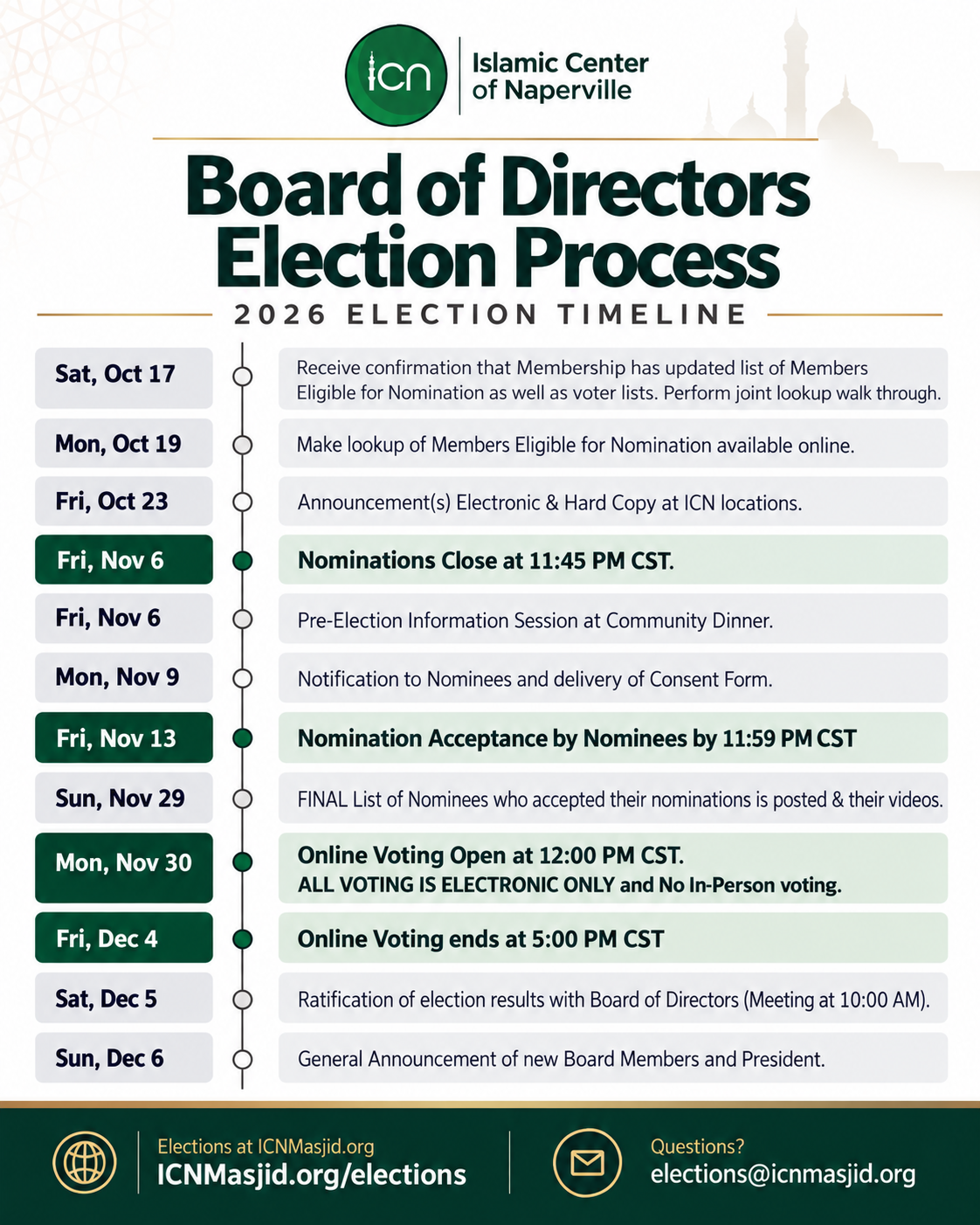
Insha Allah, this year’s elections will be held as follows:
-
Friday, November 6, 2026, by 11:45 PM
-
Monday, November 30, 2026, at 12:00 PM
-
Friday, December 4, 2026, at 5:00 PM
Nominations
Current Board Members Continuing Through 2027
The following members were elected in 2025 and will continue serving through December 2027, when their terms expire. There is no need to nominate them.
Br. Atif Fakhruddin
Br. Faiz Mohamed
Br. Mansoor Ahmed
Br. Arif Saleem
Br. Tauqeer Ahmed
Get Involved
We encourage all eligible members to take an active part in the nomination and voting process. Your involvement is vital to ensuring that our Masjid continues to thrive and serve the community effectively.
Questions?
If you need more information, please don’t hesitate to contact us:
Membership support: askmembership@icnmasjid.org
Election support: elections@icnmasjid.org
Full election details: icnmasjid.org/elections
Sincerely,
The ICN Election Committee
elections@icnmasjid.org
Policy for ICN Board Elections
Read the full policy by opening each section below.
-
Purpose. This policy establishes a structured procedure for the Election Committee to verify that candidates for the Board of Directors (a) satisfy applicable personal-conduct requirements and (b) have actively contributed to one or more ICN committees serving the ICN community during the twenty-four months immediately preceding the nomination deadline for the applicable election cycle.
Objectives. This policy and process are intended to ensure that candidates for the ICN Board of Directors are reviewed under fair, objective, and consistently applied standards and demonstrate a history of active involvement in the organization. Through this structured process, the Election Committee shall protect the integrity of the election and support the selection of trustworthy, dedicated, and experienced individuals for service on the Board.
-
Scope. This policy applies to all individuals nominated for election to the Board of Directors of the Islamic Center of Naperville (ICN).
Definitions. In this policy:
1. Nominee means an individual who has been formally notified in writing by the Election Committee that a valid nomination has been submitted for that individual.
2. Accepted Nominee means a Nominee who has accepted the nomination in writing, in the manner and by the deadline required by this policy.
3. Validated Candidate means an Accepted Nominee whom the Election Committee has determined satisfies the ICN Bylaws and this policy, for service as a candidate for the Board of Directors.
-
3.1 Requirements before service. Before beginning service, each Election Committee member shall:
(a) affirm in writing that the member will comply with the Bylaws and this policy;
(b) disclose any familial, financial, organizational, personal, or other relationship that could affect, or reasonably appear to affect, impartiality;
(c) agree to preserve the confidentiality of nominations, candidate information, complaints, deliberations, and records;
(d) agree to refrain from endorsing, opposing, or electioneering for or against any Nominee, Accepted Nominee, or Validated Candidate; and
(e) be appointed or confirmed through the process authorized by the Bylaws or the appropriate ICN governing body.
3.2 Recusal. An Election Committee member shall recuse from any matter in which impartiality may reasonably be questioned. If recusal would prevent the Election Committee from performing its duties, a qualified alternate shall be appointed through the same authorized process.
3.3 Removal. A material failure to disclose a conflict, preserve confidentiality, or maintain neutrality may result in removal from the Election Committee and other appropriate action under ICN governing documents.
3.4 Limits of review. The review of an Election Committee member shall be limited to objective qualifications, conflicts of interest, neutrality, confidentiality, and fitness to perform the assigned duties. It shall not include subjective review of personal beliefs or background unrelated to those duties.
-
Requirement. In accordance with Section 6.4.4 of the Bylaws, each Accepted Nominee shall have actively contributed to one or more ICN committees during the twenty-four months immediately preceding the nomination deadline for the applicable election cycle. The validation process shall include the steps in this section.
4.1 Documentation submission. Each Accepted Nominee shall provide a complete report of contributions to the ICN committees on which the individual served during the applicable twenty-four-month period. The report shall identify each committee, the period of service, assigned roles and responsibilities, participation and attendance when relevant, and specific contributions or accomplishments related to the committee’s charter.
4.2 Documentation verification. The Election Committee shall request the applicable committee chairperson to verify the objective facts in the Accepted Nominee’s submitted service record, limited to the period of service, assigned roles and responsibilities, participation and attendance when relevant, and specific contributions or accomplishments related to the committee’s charter.
4.3 Additional information and limits. The Election Committee may request additional objective information necessary to resolve a material discrepancy in the service record. A committee chairperson shall not be requested to provide a general character judgment or subjective assessment of personal conduct. Any specific concern regarding personal conduct shall be submitted and reviewed through the conduct-review process established by this policy, with notice to the affected Accepted Nominee and a meaningful opportunity to respond.
4.4 Reviewing contributions. The Election Committee shall examine the submitted documentation and supporting feedback, focusing on:
(a) the Accepted Nominee’s contributions to the committee’s charter and the ICN community; and
(b) the consistency and duration of the Accepted Nominee’s involvement during the applicable twenty-four-month period.
-
Standard. In accordance with Section 6.4.1 of the Bylaws, the Election Committee shall review the personal conduct of each Accepted Nominee to determine compliance with the qualifications and standards applicable to service on the Board. Any eligibility, background, or conduct review shall be based on written, relevant, consistently applied, and non-discriminatory criteria tied to the Bylaws and the duties of office. The review shall include the following.
5.1 Background review.
(a) Administration. A background review is required for an election cycle and the authorized ICN human-resources staff or authorized human-resources committee shall conduct or administer the background checks in accordance with their standards and procedures before candidate vetting begins.
(b) ICN legal counsel shall confirm the applicable legal requirements before those standards and procedures are approved or materially revised.
(c) The approved standards and procedures shall identify the scope, the authorized reviewer or approved third-party provider, the consent process, the published disqualifying or materially relevant criteria, the confidentiality safeguards, and the method for resolving incomplete or disputed information.
(d) Uniform application. The same requirements and standards shall be applied uniformly to all Accepted Nominees, with any required consent and in accordance with applicable law and ICN procedures.
(e) Handling of the report. The authorized ICN human-resources staff or authorized human-resources committee shall provide the full confidential background report only to the persons specifically authorized under the Board-approved standards and procedures to determine election eligibility. Those authorized reviewers shall receive and use no more of the report than is necessary for that determination and shall not further disclose it except as required by law or expressly authorized by the approved procedures.
(f) Relevance. No background review shall consider information unrelated to the duties, eligibility requirements, safety responsibilities, financial responsibilities, integrity expectations, or governing standards applicable to service on the Board.
5.2 Community feedback and investigation.
(a) Seeking feedback. The Election Committee shall seek relevant feedback from ICN members and shall review and investigate material feedback received from the community concerning an Accepted Nominee’s eligibility or personal conduct based on any complaints.
(b) Uniform process. Any feedback process initiated by the Election Committee shall use standardized questions, substantially similar recipient criteria, uniform response periods, and consistent documentation for all similarly situated Accepted Nominees. The Committee shall not conduct an open-ended solicitation of opinions about a named individual. Requests for information shall be limited to specific, relevant matters and administered in a manner designed to avoid rumor, gossip, selective treatment, or unnecessary disclosure.
(c) Written concerns. Any material concern considered in an adverse determination shall be submitted in writing or reduced to writing by the Election Committee and shall identify, to the extent reasonably available, the conduct at issue, the factual basis, the applicable standard, and the supporting information.
(d) Notice and opportunity to respond. The affected Accepted Nominee shall receive notice of any material concern, timely access to the material evidence relied upon (subject to necessary confidentiality protections), and a meaningful opportunity to respond before an adverse determination is made.
(e) Beliefs, values, and mission alignment. Any consideration of beliefs, values, or mission alignment shall be grounded solely in ICN’s published mission, Bylaws, governing principles, ICN Code of Conduct, and conduct expectations, and shall not be applied subjectively or selectively.
(f) Religious interpretation. A material question requiring religious interpretation shall be referred to the scholar panel or religious authority designated under the Bylaws or this policy for advisory guidance. The religious authority shall not determine disputed facts, candidate eligibility, or disciplinary consequences unless expressly authorized by the Bylaws.
-
Validation report. The Election Committee shall compile the information gathered and prepare a validation report for each Accepted Nominee.
6.1 Contents. The report shall summarize the Accepted Nominee’s contributions, the objective verification received, any material community feedback considered, and the Accepted Nominee’s response to any material concern.
6.2 Determination. The Election Committee shall make the final determination on the Accepted Nominee’s eligibility based on the validation report and the objective criteria set forth in this policy.
6.3 Confidentiality. The validation report shall be treated as confidential and made available only to authorized reviewers as necessary and consistent with ICN’s confidentiality requirements. A non-confidential eligibility summary shall be provided to appropriate parties in accordance with this policy.
-
Notice of status. The Election Committee shall notify each Accepted Nominee of the final validation status.
7.1 Eligible. An Accepted Nominee who satisfies the applicable criteria shall be confirmed as a Validated Candidate eligible for election to the Board of Directors.
7.2 Ineligible. An Accepted Nominee who does not satisfy the applicable criteria shall receive written notice of ineligibility, a concise statement of the reasons, access to the material evidence relied upon (subject to legal restrictions), and notice of any available appeal right and deadline.
-
Right to appeal. A Nominee, Accepted Nominee, or Validated Candidate whose nomination or candidacy is rejected, who is disqualified, who is deemed ineligible, or who is subjected to a penalty may submit a written appeal within the deadline stated in this policy.
8.1 Notice and access to evidence. The notice of decision shall identify the appeal deadline, the submission method, and the consequence of failing to appeal on time. The appellant shall receive timely access to the material evidence relied upon in making the challenged decision and a meaningful opportunity to respond,
8.2 Appeal panel. The appeal shall be reviewed by a neutral panel of three voting members jointly formed by the Governance Committee and the Election Committee in accordance with this policy.
(a) The panel shall include qualified persons such as the ICN resident scholar, an ICN human-resources representative, independent legal counsel, or another respected neutral community member.
(b) The panel shall be appointed before the election cycle when reasonably practicable.
(c) If fewer than three qualified panelists are available, the Governance Committee and the Election Committee shall jointly appoint qualified alternates in accordance with this policy.
(d) Every panelist remains subject to the eligibility and conflict requirements below.
8.3 Eligibility and conflicts. The following persons shall not deliberate or vote on an appeal:
(a) a current member of the Board of Directors;
(b) a current candidate;
(c) a relative of a Nominee, Accepted Nominee, or Validated Candidate;
(d) the complainant;
(e) a material witness;
(f) all Election Committee members
(g) any person with an actual or reasonably perceived conflict of interest.
A qualified alternate shall replace any unavailable or disqualified panelist.
8.4 Role of the Election Committee. The Election Committee shall provide the record and answer procedural questions but shall not deliberate or vote.
8.5 Candidate procedural rights on appeal. The Appeals Panel shall provide each appealing Candidate with (i) advance written access to the Election Committee's rejection notice, the documents on which the Committee relied, and any adverse background-review or feedback material, at least forty-eight (48) hours before the hearing; (ii) the right to appear in person or by video, and to be accompanied by a support person of the Candidate's choice; (iii) the right to submit a written response of reasonable length and to answer questions from the Panel; and (iv) a written decision within forty-eight (48) hours of the hearing, stating the reasons and citing the specific policy or Bylaw provision applied.
8.6 Review and decision. The appeal ordinarily shall be decided on the existing record; however, the panel may request limited additional information necessary to resolve a material issue. The panel shall apply the Bylaws and this policy, in effect for the applicable election cycle. It shall issue a written decision stating the outcome and a concise basis within the prescribed timeframe. The decision shall be final for purposes of the election process and shall be implemented promptly by the Election Committee.
-
Purpose and application. In accordance with Section 6.4.1 of the Bylaws, this section establishes standards of integrity, respect, professionalism, consultation, and fairness throughout the election process. The stages at which these obligations begin are set out in Section 2. These standards shall be communicated in writing and applied uniformly.
9.1 General rules. Accepted Nominees, and Validated Candidates, as applicable, shall comply with all rules and guidelines governing the election process, including the following:
(a) Honesty and integrity. They shall act honestly and with integrity and shall not engage in dishonesty, fraud, deceit, material misrepresentation, or concealment of information required by this policy.
(b) Respect and courtesy. They shall treat all persons with respect and courtesy and shall not engage in backbiting, slander, false accusation, rumor, personal disparagement, or the circulation of materially unverified allegations. A truthful, relevant concern submitted in good faith through the authorized complaint, conduct-review, or eligibility-review process shall not constitute prohibited disparagement solely because the information may be unfavorable to a Nominee, Accepted Nominee, or Validated Candidate.
(c) Confidentiality. They shall preserve the confidentiality of sensitive information obtained through the election process and shall disclose such information only as authorized by this policy.
(d) An Accepted Nominee shall not, jointly with others, do anything this section prohibits them from doing individually.
9.2 No vote solicitation or campaigning.
(a) Prohibited acts. From the time a Nominee accepts the nomination in writing and receives the applicable election rules and deadlines, the Accepted Nominee or Validated Candidate shall not:
(i) solicit or request votes;
(ii) initiate or conduct an unauthorized promotional campaign;
(iii) distribute unauthorized campaign materials;
(iv) offer or facilitate any gift, favor, benefit, or inducement connected to a vote;
(v) exert or encourage pressure upon a voter; or
(vi) misuse ICN resources to support or oppose a candidate.
(b) Permitted responses. An Accepted Nominee or Validated Candidate may respond truthfully and directly to a member’s question concerning that individual’s qualifications, service record, experience, or plans, provided that the response is reasonably responsive to the inquiry and does not include vote solicitation, boasting, materially misleading information, disparagement, pressure, inducement, or repeated unsolicited follow-up.
(c) Permitted participation and member discussion. Participation in standardized candidate statements, forums, interviews, or communications administered equally under this policy shall not constitute prohibited campaigning. ICN members retain the right to discuss relevant candidate qualifications, nominate eligible persons, exchange truthful information, and advise one another in good faith, subject to the requirements of verification, confidentiality, respectful conduct, and non-coercion.
(d) Conduct through others. An Accepted Nominee or Validated Candidate shall not cause, request, authorize, coordinate, encourage, or knowingly accept through another person conduct that the individual is prohibited from undertaking directly. Independent conduct shall not be attributed to the individual without reliable evidence of authorization, coordination, encouragement, knowing acceptance, or other material participation. Upon learning of unauthorized activity conducted for that individual’s apparent benefit, the individual shall promptly direct that the activity stop, notify the Election Committee, and take reasonable corrective action, including written disavowal when appropriate.
(e) Examples of prohibited conduct. Prohibited conduct includes:
(i) Direct contact with voters. Initiating unsolicited or repeated communications, including phone calls, emails, messages, or in-person meetings, to request votes, exert pressure, or engage in unauthorized advocacy for or against a candidate. This restriction does not prohibit a truthful and reasonably responsive answer to a member’s question concerning an Accepted Nominee’s or Validated Candidate’s qualifications, service record, experience, or plans when the response otherwise complies with this policy.
(ii) Organizing events. Hosting events such as rallies, fundraisers, or meetings where the primary purpose is to support or oppose a candidate.
(iii) Using social media. An Accepted Nominee or Validated Candidate shall not initiate or coordinate unauthorized promotional posts, groups, messages, or content intended to solicit votes, exert pressure, disparage another candidate, or otherwise conduct prohibited campaigning. This restriction does not prohibit truthful responses or good-faith member consultation permitted under this policy.
(iv) Leveraging ICN resources. Using the resources of ICN, such as its facilities, staff, or communication channels, to support or oppose a candidate.
9.3 Election deadlines and timely participation. Election deadlines are material because the election operates on a fixed schedule.
(a) Every notice requiring action shall state the applicable deadline, submission method, and consequence of nonresponse.
(b) A Nominee, Accepted Nominee, Validated Candidate, complainant, witness, committee, or panel shall act without unreasonable delay.
(c) An extension may be granted only for documented good cause, shall be limited to the time reasonably necessary, and shall not materially prejudice another person or the election schedule.
(d) If a person fails to respond by the applicable deadline without an approved extension, the Election Committee or appeals panel shall proceed on the available record.
(e) Delay intended to obstruct vetting, enforcement, appeal, or orderly administration of the election constitutes a violation of this policy.
9.4 Candidate materials. Any biography, statement, video, or related information distributed for a Validated Candidate shall be subject to the same format, length, submission deadline, review process, and distribution method for all Validated Candidates.
9.5 Monitoring and enforcement. The Election Committee shall monitor compliance with the Code of Conduct, address complaints, and enforce proportionate consequences for violations. This includes:
(a) Complaints and initial review. A complaint shall be submitted in writing and shall identify, to the extent reasonably available, the alleged conduct, the policy provision involved, the persons involved, the approximate date, and supporting information. The Election Committee may consider an anonymous complaint only when it contains sufficiently specific and reliable information that can be independently evaluated. The Election Committee shall dismiss allegations that, even if true, would not constitute a violation or that lack a reasonable factual basis.
(b) Notice and opportunity to respond. Before imposing disqualification, future election ineligibility, or any other penalty, the Election Committee shall provide the Nominee, Accepted Nominee, or Validated Candidate, as applicable, with written notice of the alleged violation, a summary of the basis for the allegation, and a reasonable opportunity to respond in accordance with this policy.
(c) Warnings. Initial violations may be addressed with formal warnings. Formal warnings shall be documented and shall remind the Nominee, Accepted Nominee, or Validated Candidate of the obligation to comply with the Code of Conduct.
(d) Disqualification. In severe cases, an Accepted Nominee or Validated Candidate who engages in serious misconduct shall be disqualified from the election, subject to notice and appeal rights under this policy.
(e) Findings and proportionality. A violation shall be found only when the available reliable information reasonably substantiates the alleged conduct. The written decision shall identify the applicable rule, material facts, finding, and consequence. Any consequence shall be proportionate to the seriousness of the violation, considering intent, knowledge, repetition, actual or potential harm, effect on election fairness, misuse of ICN resources, breach of confidentiality, prior notice or warning, benefit obtained, cooperation, prompt disavowal, and corrective action. Disqualification or future-election ineligibility shall be reserved for serious, repeated, intentional, or materially outcome-affecting conduct, subject to the appeal process.
(f) Corrective action. A Nominee, Accepted Nominee, or Validated Candidate who violates the Code of Conduct may be required to issue a clarification, retract or correct an improper communication, provide a written acknowledgment, cease prohibited activity, or take another proportionate measure reasonably necessary to restore fairness, correct misinformation, protect affected rights, or safeguard ICN. Corrective action shall not be punitive beyond what is reasonably necessary and shall never be imposed for the purpose of humiliating or publicly shaming any person.
(g) Future election eligibility. If the Election Committee determines, based on documented findings and consistent application of this policy, that a Nominee, Accepted Nominee, or Validated Candidate has committed a serious violation of the Election Code of Conduct, that individual shall be deemed ineligible for acceptance as a candidate for one election cycle, subject to any applicable appeal rights under this policy. Seriousness shall be determined based on the individual’s intent, the harm caused, repeated conduct, the impact on election fairness, misuse of ICN resources, breach of confidentiality, or other materially relevant circumstances.
(h) Recordkeeping. The Election Committee shall maintain written records of complaints, notices, responses, evidence reviewed, findings, enforcement decisions, appeals, and final outcomes. Such records shall be retained in accordance with ICN’s document-retention practices and made available to authorized reviewers as appropriate and consistent with confidentiality requirements.
-
Offering the session. Before nominations close, the Election Committee may offer a general information session open on equal terms to all eligible ICN members who are considering Board service.
10.1 Content. The session shall use standardized materials and explain:
(a) Board responsibilities;
(b) eligibility requirements;
(c) contribution validation and personal-conduct review;
(d) nomination and acceptance steps;
(e) Nominee-stage and candidate-stage obligations;
(f) Campaigning restrictions;
(g) deadlines;
(h) complaints, enforcement, and appeals;
(i) confidentiality; and
(j) available candidate-information opportunities.
10.2 Limits. The session shall not disclose confidential prior cases or identify attendees as prospective Nominees or candidates.
10.3 Equal access. Reasonably equivalent written materials, and a recording when practicable, shall be made available so that attendance does not create an informational advantage.
-
Results report. After voting closes and any timely election objections or appeals are resolved, the Election Committee shall prepare a confidential results report for the Board of Directors. The report shall identify the certified results and any material procedural issues requiring Board review.
Ratification. The Election Committee shall present the results report to the Board of Directors for ratification in accordance with the ICN Bylaws and approved election procedures. The Board shall ratify the results after confirming that the election was conducted in substantial compliance with the Bylaws and this policy.
Public communication and confidentiality. Public communication of final election results shall be made by the Election Committee and shall identify the certified outcome. Vote totals shall not be publicly disclosed unless the Bylaws, this policy, or the Board of Directors expressly authorize their disclosure. Ballots, voter information, objections, appeal materials, and internal deliberations shall remain confidential except as required for the election process or by applicable law.
-
The principles that form the foundation (provided by Mufti Rizwan Ali)
Office is a trust. Allah commands that trusts be given to those fit for them (4:58). The Prophet ﷺ warned against those who ask for or are eager for authority (Bukhari and Muslim), and told ʿAbd al-Raḥmān ibn Samura not to seek leadership (Bukhari and Muslim). He described authority as an amanah that is a source of regret for those who do not fulfill it (Muslim).
The community has a right to consult. “Their affairs are by consultation” (42:38; see also 3:159). Consultation has been part of how our community chooses its leaders, so members should be able to discuss who is fit to serve.
Honesty about one’s qualifications is not self-promotion. Yusuf ʿalayhi al-salām spoke plainly of his ability when the need required it (12:55), and the daughter of Shuʿayb described the best person to hire as strong and trustworthy (28:26). What is discouraged is self-praise (53:32) and seeking office for its own sake.
Speech must be governed by adab. Ghībah (backbiting) is forbidden (49:12), as are buhtān (slander; Muslim) and namīmah (tale-bearing; 68:11; Bukhari and Muslim). A report about a person should be verified before action is taken on it (49:6).
Fairness in judging. The Prophet ﷺ told ʿAlī not to decide between two parties until he had heard both (Abu Dawud, Tirmidhi).
We keep our agreements. “Muslims are bound by their conditions,” except a condition that makes the lawful unlawful or the unlawful lawful (Abu Dawud, Tirmidhi). The Bylaws are the community’s shared agreement, so ICN policies should be consistent with them and should state precisely what is prohibited.
-